One of my concerns with our self-sufficient dream home has been our ability to be self-sufficient in potable water here on the arid plains. Well, my problem may be solved by the time I get around to actually building. I give you the Whisson Windmill, which collects water from the air:
This device has the potential to produce up to 2,000 gallons of water a day.
Showing posts with label dream home. Show all posts
Showing posts with label dream home. Show all posts
Tuesday, August 11, 2009


Saturday, May 30, 2009
The Google and Dog Runs
Sometimes I retain bits of information without knowing where I got them. I recently commented to wifey that in my dream home I wanted a sort of dog run. She didn't understand what I meant. I explained that it was where a house was separated with a covered area that allowed a breeze, thus helping cool the house.

As is my wont, I googled the term to show her a picture. I was chagrined to find that everything connected to the term "dog run" had to do with kennels and chain-link fences. It wasn't until I added the word porch to the search that I was finally able to get the proper hits.

From the Handbook of Texas Online: "DOG-RUN HOUSES. The dog-run, dog-trot, or double log cabin was a common type of house in Texas at the middle of the nineteenth century. The building consisted of two cabins separated by a ten or fifteen foot passageway, with a continuous gabled roof covering both cabins and the passageway between them, or dog-run...."
Saturday, July 19, 2008
Latest Reading List

A list of some of the reading I've done over the last eighteen months or so -- in addition to the hundreds of documents I've looked at online. I've got to get outside more.
.
Tocqueville in America, by George Wilson Pierson. Reading in progress. With 852 pages to read, I'm not rushing to finish. I'm trying to find out more about the man who wrote so perceptively about America nearly two hundred years ago.
.The Conservative Mind, by Russell Kirk. An in-depth analysis of the roots of Conservatism from a historical perspective. I want to understand why I believe the things I believe. (Basically, the "latest fashionable idea" (e.g., reflexive government action on "manmade global warming") doesn't carry as much weight as centuries of collective wisdom.
.The Millionaire Next Door by Thomas J. Stanley, Ph.D and William D. Danko, Ph.D. An analysis of how millionaires got to be that way. One salient point: Income does not necessarily equal wealth.
.Powers of Mind, by Adam Smith. Re-read for about the fifteenth time. One of the best-written non-fiction books of all time. It happens to be about all the mysticism and science surrounding the abilities of the human mind.
.The Key, by Joe Vitale. For research on self-help books.
.You Were Born Rich, by Bob Proctor. Ditto.
.Rain Fall, Hard Rain and Requiem for an Assassin, all by Barry Eisler. Eisler spoke at a writers conference I attended, and I wanted to familiarize myself with his work before I heard him speak. He was very cordial and encouraging to all participants, including me. I think I became "That Guy" by accosting him in the hallway a couple of times with questions. If you ever read this, Barry, I apologize.
.Finding Your Voice, by Les Edgerton. Another book on writing. How to put your own personality into your writing.
.The 101 Habits of Highly Successful Screenwriters, by Karl Iglesias
Rebel Without a Crew, by Robert Rodriguez.
Filmmaking for Teens, by Troy Lanier & Clay Nichols.
Lew Hunter's Screenwriting 434, by Lew Hunter.
Setting Up Your Shots, by Jeremy Vineyard.
$30 Film School, by Michael W. Dean
Screenwriters on Screenwriting, by Joel Engel.
Filmmaking for Dummies, by Bryan Michael Stoller.
Adventures in the Screen Trade, by William Goldman.
.All of the above because of my intense, but brief, interest in writing, producing and directing a film. Ultimately, I had to admit that I can't be a filmmaker. Hopefully the knowledge I gained will come in useful at some point, but I don't have the drive to actually make films. Life is too short and I have too many other more compelling interests that take up my time. I had to choose something to sacrifice, and filmmaking was it.
.Low-Carb Dieting for Dummies, by Katherine B. Chauncey, Phd, Rd. Chauncey is an Associate Professor in the Department of Family and Community Medicine at Texas Tech University School of Medicine. Not really an Atkins-like approach to carbohydrates, but more of a "whole foods" diet. Designed to encourage the eating of "good" carbs like fresh vegetables and fruit. Common sense dieting, which I need to do more of.
.Scene & Structure, by Jack M. Bickham. Another book on writing, re-read for about the fifth time. The most amazing approach to how to get from point A to point B in writing fiction, based on a simple cause/effect sequence.
.The Compleat Gentleman, by Brad Miner. The subtitle -- The Modern Man's Guide to Chivalry -- pretty much says it all. How to translate the lessons from all the stories about great men into our own lives..
.
The Complete Idiot's Guide to Solar Power for Your Home, by Dan Ramsey. More research for the "dream home" that I'm designing and hope to build in ten or twelve years. Big challenge I face: How does one go about being water self-sufficient in arid west Texas?
.On Writing, by Stephen King. A writing book by the author voted Greatest Living American Writer by the readers of Writers Digest. A few nuts and bolts on writing, lots of biography, with details about the accident that almost killed him. Best part: the section on his and his wife's reactions when his novel Carrie made them rich.
.Picks & Shovels, by Dee Burks & Liz Ragland. The writing book that put me on course to my current career.
.
Gettysburg, by Newt Gingrich and William R. Forstchen. An alternative-history novel about the Battle of Gettysburg. What if Lee's Southern troops had won that battle? This book stimulated my interest in the real battle, even to the point of buying the DVD of the movie Gettysburg.
.
.
Mobocracy, by Matthew Robinson. A book which documents what I've understood for a long time -- the mainstream media use polls to create news, rather than report it.
.
Crucial Conversations, by Kerry Patterson and others. Fantastic book on how to talk about subjects which are hard to discuss. As much as I talk, I'm guilty of avoiding hard discussions sometimes. This book gives tips on how to talk about things without destroying relationships.
.
.
Bare Knuckles and Back Rooms, by Ed Rollins. The architect of Ronald Reagan's 1984 presidential campaign talks about his life.
.
Freakonomics by Stephen Dubner and Steven Levitt. An unusual use of economic theory and techniques to analyze issues facing American society.
.
All seven Harry Potter books, by J.K. Rowling. Actually, I listened to the first six on mp3 and then actually read the last book. I avoided these books for years because every time I started the first one it came across as juvenile. Once I began listening to the first one, however, I got hooked on the story -- which got progressively more mature as the story progressed. Amazing phenomenon.
Sunday, June 04, 2006
An Inconvenient Rumor
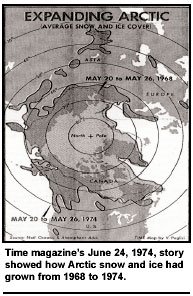
The Fire and Ice Report from the Business and Media Institute shows how so-called experts have been predicting dire climate changes for over 100 years. The problem is that they haven't been able to decide if it's getting hotter or colder. According to the report, in the 1890's the world was getting colder. In the 1970's there was another Ice Age coming, and we were all doomed. In the 1980's there was a major comeback for global warming, and it's been the undisputed champion of climate change theories since.
There is a lot of junk science out there, and it seems that every "expert" has a dog in the hunt -- grant money, political power, prestige -- so that it's impossible to trust anyone's opinion completely. Al Gore has based almost his entire political career on environmental issues, most recently in his documentary, "An Inconvenient Truth."
JunkScience.com is a website that goes into detail about some of the fallacies regarding science, global warming theories in particular. For a skeptic like myself, it's a great source of information on various aspect of the popular media's coverage of scientific issues.
Lest anyone think I want dirty water and air pollution, I am against both of those. I also think that it's prudent to conserve resources whenever and wherever possible. In fact, my "dream home" will -- if all goes according to plan -- be almost entirely off the grid. I have a few years before I actually have to pull the trigger on it, but I'm already looking at solar alternatives, and other ways to be more self-sufficient. We are stewards of our world, and need to do what we can when we can.
That does not mean the government needs to do anything. It's each person's individual choice, and as an individual I want to be a good steward.
But it's not because of Al Gore.
Thursday, June 01, 2006
Recent Reading List
I've been busy with both research and reading for pleasure. Here are some of the books I've been into lately.
Lend Me Your Ears: Great Speeches in History by William Safire. Amazing how many situations that we're dealing with now have been discussed in the past.
The Big Book of Noir edited by Ed Gorman, Lee Server and Martin H. Greenberg. Part of the research for my novel. A collection of articles on noir films, stories, radio and television. One of the best noir writers, Charles Williams, was from San Angelo, Texas. Go figure.
How To Talk To a Liberal (If You Must) by Ann Coulter. A humorous, sharp-tongued collection of her columns.
The Devil's Dictionary by Ambrose Bierce. Not what my 13-year-old daughter thought it was. Bierce was H.L Mencken before Mencken was.
The Abs Diet by David Zinczenko. Because I recently turned 48 years old, and hope springs eternal.
Life Matters by Roger and Rebecca Merrill. Trying to get a handle on life. I mainly bought this because The 7 Habits of Highly Effective People by Stephen Covey rocked my world, and I thought this would add to that.
How to Read a Book by Mortimer Adler and Charles Van Doren. An odd choice maybe, but my reading habits have gotten sloppier as I get older, and this book is a big help in being a better reader. A key passage: "It is true enough that many people read some things too slowly, and that they ought to read them faster. But many people also read some things too fast, and they ought to read those things more slowly. A good speed reading course should therefore teach you to read at many different speeds, not just one speed that is faster than anything you can manage now. It should enable you to vary your rate of reading in accordance with the nature and complexity of the material." True dat, as my kids say.
No Country for Old Men by Cormac McCarthy. Because of the type of story I'm writing, I googled the term "Texas noir" and this book came up. This story set in west Texas by an award-winning author will break your heart. Read it at your own risk.
The Da Vinci Code by Dan Brown. I first read this book a couple of years ago, and didn't think much of it. It's as though a puzzle geek put all these different puzzles and codes into a sub-par short story. Now that it's sold a zillion copies and been made into a bad movie, I read it again, and my opinion hasn't changed. A travelogue through Christian symbolism and conspiracy theories.
The Western Guide to Feng Shui by Terah Kathryn Collins. If you don't know a bagua map from a cheese log, then this book is for you. Forget any mumbo-jumbo you might have heard about feng shui; this book gives practical guidelines like: 1) Live with what you love. 2) Put safety and comfort first. 3) Simplify and organize. I read this book while working on the design for the dream home Kathy and I hope to build when we turn 60.
Stein on Writing by Sol Stein. Because I'm a compulsive buyer and reader of books on writing. This book has a lot of good stuff, but one page is marked because of this passage: "When I ask a group of professional writers to state the essential difference between nonfictionand fiction, most are unable to do so.... Let us state the difference in the simplest way. Nonfiction conveys information. Fiction evokes emotion." Strunk and White couldn't have said it better.
Speaker's Sourcebook II by Glenn Van Ekeren. Because I had a presentation to do, and needed a quick quote about risk. (The quote I chose: "You've got to go out on a limb sometimes, because that's where the fruit is." - Will Rogers)
Lend Me Your Ears: Great Speeches in History by William Safire. Amazing how many situations that we're dealing with now have been discussed in the past.
The Big Book of Noir edited by Ed Gorman, Lee Server and Martin H. Greenberg. Part of the research for my novel. A collection of articles on noir films, stories, radio and television. One of the best noir writers, Charles Williams, was from San Angelo, Texas. Go figure.
How To Talk To a Liberal (If You Must) by Ann Coulter. A humorous, sharp-tongued collection of her columns.
The Devil's Dictionary by Ambrose Bierce. Not what my 13-year-old daughter thought it was. Bierce was H.L Mencken before Mencken was.
The Abs Diet by David Zinczenko. Because I recently turned 48 years old, and hope springs eternal.
Life Matters by Roger and Rebecca Merrill. Trying to get a handle on life. I mainly bought this because The 7 Habits of Highly Effective People by Stephen Covey rocked my world, and I thought this would add to that.
How to Read a Book by Mortimer Adler and Charles Van Doren. An odd choice maybe, but my reading habits have gotten sloppier as I get older, and this book is a big help in being a better reader. A key passage: "It is true enough that many people read some things too slowly, and that they ought to read them faster. But many people also read some things too fast, and they ought to read those things more slowly. A good speed reading course should therefore teach you to read at many different speeds, not just one speed that is faster than anything you can manage now. It should enable you to vary your rate of reading in accordance with the nature and complexity of the material." True dat, as my kids say.
No Country for Old Men by Cormac McCarthy. Because of the type of story I'm writing, I googled the term "Texas noir" and this book came up. This story set in west Texas by an award-winning author will break your heart. Read it at your own risk.
The Da Vinci Code by Dan Brown. I first read this book a couple of years ago, and didn't think much of it. It's as though a puzzle geek put all these different puzzles and codes into a sub-par short story. Now that it's sold a zillion copies and been made into a bad movie, I read it again, and my opinion hasn't changed. A travelogue through Christian symbolism and conspiracy theories.
The Western Guide to Feng Shui by Terah Kathryn Collins. If you don't know a bagua map from a cheese log, then this book is for you. Forget any mumbo-jumbo you might have heard about feng shui; this book gives practical guidelines like: 1) Live with what you love. 2) Put safety and comfort first. 3) Simplify and organize. I read this book while working on the design for the dream home Kathy and I hope to build when we turn 60.
Stein on Writing by Sol Stein. Because I'm a compulsive buyer and reader of books on writing. This book has a lot of good stuff, but one page is marked because of this passage: "When I ask a group of professional writers to state the essential difference between nonfictionand fiction, most are unable to do so.... Let us state the difference in the simplest way. Nonfiction conveys information. Fiction evokes emotion." Strunk and White couldn't have said it better.
Speaker's Sourcebook II by Glenn Van Ekeren. Because I had a presentation to do, and needed a quick quote about risk. (The quote I chose: "You've got to go out on a limb sometimes, because that's where the fruit is." - Will Rogers)
Subscribe to:
Posts (Atom)